

Ayer’s Cliff school governing board adopts resolution to keep neighbourhood kids at École St-Barthélemy
Education
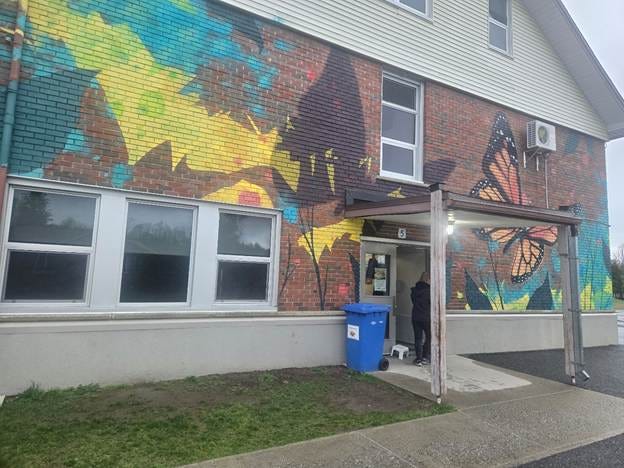
The entrance to École St-Barthélemy in Ayer’s Cliff, photographed shortly before Wednesday evening’s governing board meeting. A colourful mural of sunflowers and monarch butterflies covers the school’s brick facade. Photos and video were not permitted during the meeting. | William Crooks, The Pulse of the Eastern Townships
Get local news like this every morning. Subscribe free below.
Pulse Newsroom
The governing board of École St-Barthélemy in Ayer’s Cliff has adopted a formal resolution demanding the Centre de services scolaire des Sommets (CSSDS) continue accepting out-of-territory students and pursue a permanent provincial boundary change that would stop more than 25 local children from being forced out of their neighbourhood school.
The resolution was adopted Wednesday evening after more than 40 parents packed the meeting to push back against signals from the CSSDS that out-of-territory students might not be accepted for the 2026–2027 school year. The school sits at the junction of three school service centres — an administrative quirk dating to the last provincial school territory redrawing in 1997 — leaving dozens of children classified as “out-of-territory” despite living within five kilometres of the building, some close enough to walk or bike.
Serge Dion, assistant director general responsible for school organization at the CSSDS, told parents the service centre is legally required to serve students within its own territory before accepting others. He cited a record number of applications this year for specialised classes for students with particular needs as the main driver of capacity pressure.
“Our intention is to open the group,” Dion said, adding the CSSDS wants at minimum to allow currently enrolled out-of-territory students to finish their primary schooling at St-Barthélemy. He cautioned that even if the additional primary group opens, individual placement confirmations cannot be issued until after August 15 due to the possibility of in-territory enrolment increasing before then.
The roughly 30 affected students — about 20 currently enrolled and around 10 new registrants — would otherwise be sent to École de Waterville (Centre de services scolaire de la Région-de-Sherbrooke) or École de Barnston (CSS des Hauts-Cantons), both already at or near capacity. Attendees at the meeting also noted that two school buses from different service centres currently travel the same roads in opposite directions, and that displaced children would face commutes exceeding one hour compared to trips that currently take minutes.
The adopted resolution opposes any non-admission of students from other school service centres, requests status quo enrolment for 2026–2027 and every subsequent year until a territory change is finalised, and calls on the CSSDS to support a formal territory modification under Article 116 of the Act Respecting Public Instruction — the only legal mechanism that can permanently resolve the boundary issue. Only the provincial government can enact such a change by decree.
Dion acknowledged a prior attempt by the CSSDS at a similar territory modification — involving a different local sector — failed after more than half the families in that area chose to stay with their existing school, and a split between primary and secondary school territories could not be reconciled under provincial rules. He told parents Wednesday that if a majority of parents mobilise in favour of a territory change, the CSSDS would collaborate and help coordinate with the directors general of the other two affected service centres.
A parent, whose son attends the school and who first brought the issue to public attention, noted in a message shared with The Pulse that the CSSDS had shown no intention of acting on the territory question and that MNA Gilles Bélanger had received no response from the service centre on the matter.
The resolution calls on the board’s presiding officer to forward the adopted text to all concerned school service centres, their governing boards, and elected representatives. It also formally requests that the CSSDS acknowledge the negative impact a contrary decision would have on the well-being, academic success, and quality of life of the children involved.
A final CSSDS decision on whether to open the additional primary group for 2026–2027 is expected by mid-June.
Don’t miss the next story that affects your community.
Join thousands of readers getting The Pulse every morning—plus breaking news alerts when it matters most.
If you value this kind of local journalism, consider supporting it.
Subscribe, share and like!