

Compton-Stanstead MP tables bill to fix rural cell coverage gaps and outdated spectrum rules
Politics
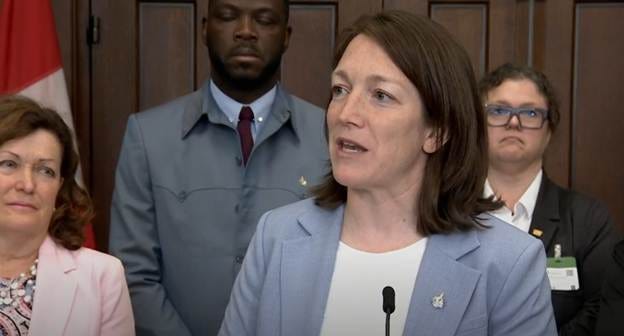
Marianne Dandurand, Liberal MP for Compton-Stanstead, addresses reporters in Ottawa on Monday during a press conference for Bill C-268, her private member’s bill aimed at improving rural cellular coverage across Canada. Photo: CPAC
Get local news like this every morning. Subscribe free below.
Pulse Newsroom
A Compton-Stanstead MP brought together municipal leaders, farmers, a grocery store owner, and a domestic violence shelter director in Ottawa on Monday to put a human face on what she called a public safety crisis hiding behind misleading statistics — Canada’s incomplete and unreliable rural cellular coverage.
Marianne Dandurand, the Liberal MP for Compton-Stanstead and president of the party’s Rural Caucus, presented Bill C-268 before reporters alongside representatives from across her Eastern Townships riding, including Jacques Demers, president of the FQM; Michel-Henri Goyette, mayor of Martinville; Anick-Nadia Gauthier, mayor of East Hereford; Dominique Arsenault, owner of IGA Coaticook; Michel Brien, president of UPA Estrie; and Andrée Gagnon of La Maison-Séjour, a women’s shelter.
The bill has two core objectives: requiring independent verification of cellular coverage data, and modernizing a spectrum policy framework Dandurand says has not been updated since 2007.
“In 2026, access to cellular service should not depend on where you live,” Dandurand said, challenging the federal government’s claim that 97 per cent of Canadian territory is covered. “I think that several people here could testify to a certain doubt about this effect.”
A town cut off for 16 hours
Martinville Mayor Michel-Henri Goyette provided the press conference’s most striking testimony, describing what happened on April 22 when a road accident severed a fibre optic line passing through a neighbouring municipality.
“For 16 hours, Martinville was plunged into nothingness, unable to communicate with the outside world in any way,” Goyette said. The only option for residents who needed to reach someone was to get in their cars and drive until they found a signal. “No internet, no telephone, no cell phone — in 2026, at 20 minutes from an urban centre of more than 200,000 inhabitants.”
Goyette pointed out that the situation was, in one sense, worse than it would have been a quarter century ago: 25 years back, Martinville had no high-speed internet and no cellular coverage, but landlines kept the community connected even during power outages. Those copper lines are now gone, replaced by fibre and VoIP, meaning a single point of failure can sever all communications simultaneously.
“It is time to change the rules. Rural communities need cellular coverage. It is a matter of public safety,” he said.
Grocery deliveries and employee safety
Dominique Arsenault, owner of IGA Coaticook and a representative of the Canadian Federation of Independent Grocers, described the daily operational and safety challenges facing rural businesses.
“It becomes a challenge also for the entire population, who sometimes lives with physical limitations, where we make deliveries at home, not able to pay if we don’t have cell phone signal,” Arsenault said.
He noted that Coaticook’s problems are far from unique. “As soon as we get out of the big centres, connectivity is a problem. What is true at Coaticook is also true for the rest of Canada.”
This kind of local reporting doesn’t show up in your feed by accident.
Get it delivered daily by subscribing below.
Life-or-death stakes at a women’s shelter
The most urgent testimony came from Andrée Gagnon of La Maison-Séjour, a shelter for women fleeing domestic violence in the Compton-Stanstead riding. Gagnon described a power outage on April 1 — the fifth in five months — that left the shelter without any means of contacting the outside world for nearly three hours.
She described a catalogue of past emergencies that required 911 calls: a suicide attempt, a drug overdose requiring ambulance dispatchers to guide staff through administering naloxone over the phone, a resident hospitalised for severe hyperglycemia, a child’s epileptic seizures, and at least one incident in which an abuser tracked down the shelter’s location.
“For a women’s shelter for victims of domestic violence and their children, connectivity is sometimes a matter of life or death,” Gagnon said. “During those three hours when the power was out, we held our breath, hoping that no dangerous situation would occur.”
She added that anti-approach bracelets worn by abusers have gaps in zones without connectivity, and that women fleeing dangerous situations have been unable to locate the shelter because GPS fails without a signal. The shelter housed 42 women and 26 children in 2025–2026.
Cross-partisan support, questions on cost
Dandurand confirmed the bill has the support of opposition members as co-signers, as well as a Senate sponsor in Senator Réjean Aucoin. Asked whether the government also backs the bill, she said: “Yes, they have the support of the government as well.”
A reporter challenged her on whether forcing carriers to expand infrastructure would drive up bills for urban subscribers. Dandurand pushed back, arguing government subsidies already support tower construction and that emerging technologies change the calculus.
“When we deploy new technologies, such as low-orbit satellites, these technologies must also prioritize the regions — and it will not cost more to connect the regions from the satellite than to connect the cities,” she said.
Asked why she was advancing the measure as a private member’s bill rather than a government bill, Dandurand said the targeted regulatory changes the legislation requires don’t need to wait for a full government legislative process. “It’s just accelerating things. The important thing is to ensure that it remains a priority, which it already is.”
Bill C-268 is currently at second reading in the House of Commons.
Don’t miss the next story that affects your community.
Join thousands of readers getting The Pulse every morning—plus breaking news alerts when it matters most.
If you value this kind of local journalism, consider supporting it.
Subscribe, share and like!