

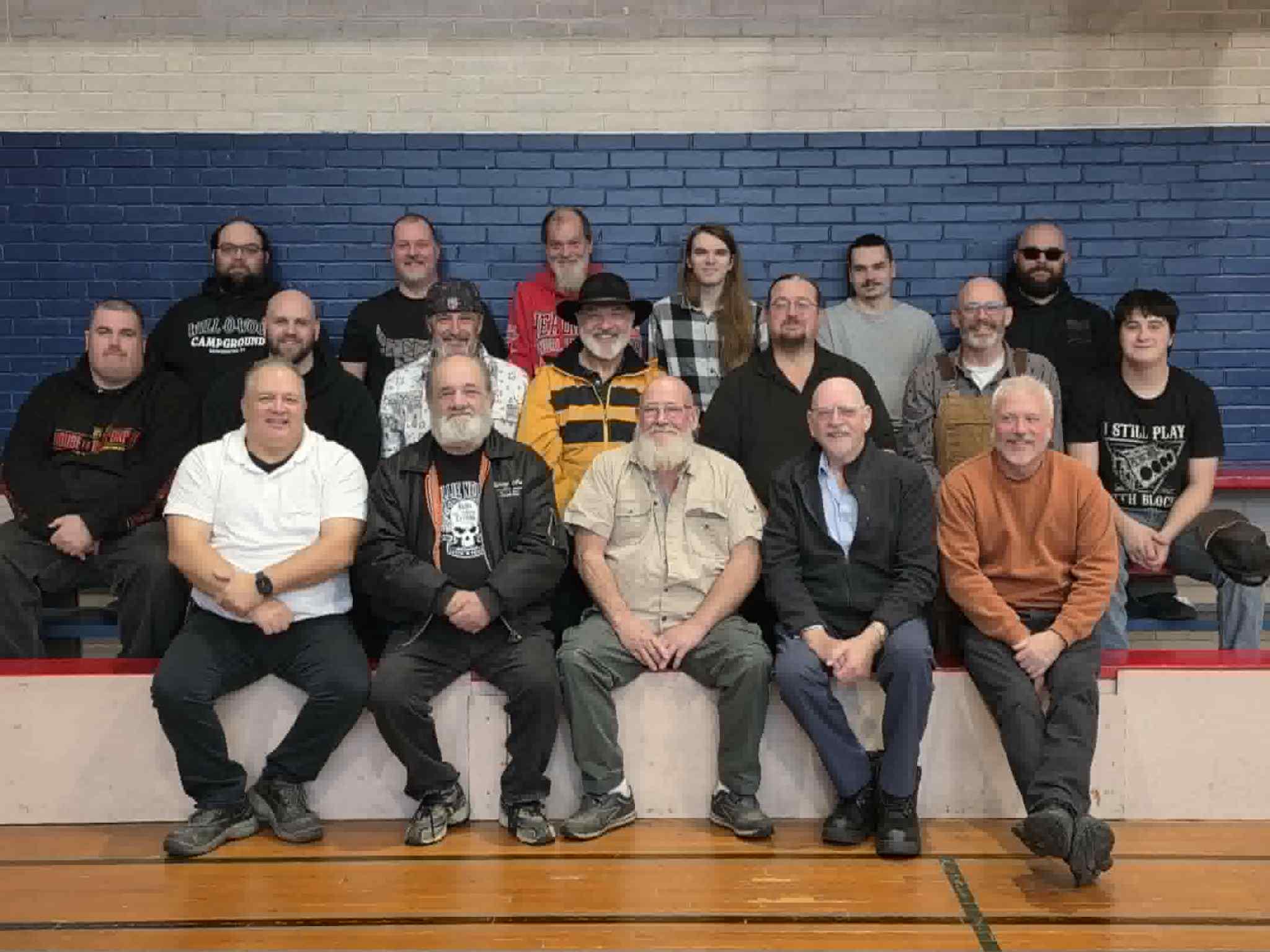
Attendees of the wrap-up event, sent in after the gathering by ETWA organizer D.J. Myers, include past and present wrestlers, referees, family members, and supporters celebrating more than three decades of Eastern Townships Wrestling Association history. Courtesy of D.J. Myers.
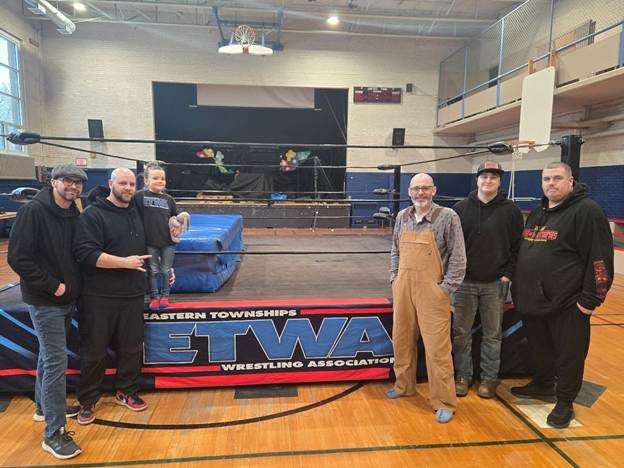
Wrestlers, organizers, documentary directors and a young fan gather in front of the ETWA wrestling ring just before the wrap-up event celebrating more than 30 years of the Eastern Townships Wrestling Association. Photos and video by William Crooks.
Doug Myers helps his daughter train to one day perhaps join the family business.
Pulse Newsroom
The story of the Eastern Townships Wrestling Association (ETWA) — and the family that built it — is being brought to life in a new feature documentary by Ottawa-based filmmaker Damon Cox, who has spent the past three years capturing the Myers family’s decades-long impact on wrestling and community life across the Townships.
Cox, who has worked in film since graduating in 2002, said the project grew naturally out of his friendship with the Myers family and his admiration for their grassroots wrestling organization. “I’d like to share the story of this family and the legacy and what’s developed and their impact on the community and other surrounding communities as well,” he said Nov. 16 in person in Stanstead.
From Stanstead to Ottawa
Cox first came to know the Myers family through his time living in Stanstead beginning in 2008. He was working locally — including a stint at Millies Diner — when he began collaborating with community events such as ShazamFest, where he met D.J. and Doug Myers, sons of ETWA founder Donny Myers.
He soon found himself drawn into the spectacle of local wrestling. “Doug came knocking on my door one day and said, ‘Hey, we’ve got a show in Weir Park. Can you come shoot it for us?’” Cox said. “That’s when I started documenting and following the Myers family and collecting footage with them.”
Over the years, Cox relocated to Ottawa, where he continued to build his filmmaking network through his production company, Mullangio Pictures. But the connection to the Townships — and to ETWA — never left him. When Doug called again in 2022 after the pandemic hiatus to ask if he could film a comeback show, Cox agreed without hesitation.
He brought along his friend and cinematographer Jesse Palangio. “Jesse was just blown away,” Cox said. “He was really impressed with the professionalism. He said, ‘These guys have flair.’ And I said, ‘yeah — they’ve grown so much, and I’ve known them for years. It’s incredible to see how far they’ve come.’”
A story about more than wrestling
Cox said that what began as a simple plan to film a few matches quickly evolved into something much larger. “This is more than just a wrestling story,” he said. “It’s a story about family, and it’s a story about community.”
He describes the film as a kind of rural Canadian parable — one that celebrates the relationships, perseverance, and creativity that sustain small-town life. “We want to take that very universal approach of family and relationships and community, and especially the impact of rural communities,” Cox said. “Stanstead is very near and dear to me... I still have many fond memories of my involvement with the community here.”
He said the film highlights the intergenerational evolution of ETWA, from backyard beginnings and homemade props to the polished, crowd-pleasing performances that now draw fans on both sides of the Canada–U.S. border. “There’s a sense of Canadiana to it,” Cox said, “and a cross-border appeal as well because they also do shows in Vermont.”
Telling a legacy with heart
For Cox, the project has also been deeply personal. “It means a lot to me to have developed such a close relationship with this family and have the ability to be on the inside,” he said. “I consider D.J. one of my best friends. Doug as well. Donny — I feel like there’s a friendship but also a bit of a father figure there. I care deeply about them.”
That connection made the filmmaking process both rewarding and emotional. During filming, the family shared personal moments, including Donny Myers’ battle with cancer. “That really deepened the story,” Cox said. “It started out just about the wrestling, but over time it became about legacy — what it means to pass something down, to keep building something even when life throws challenges at you.”
He added that the family’s determination mirrored his own as an independent filmmaker. “We’ve been funding this solely out of our own pockets,” he said. “Even though we applied for funding here and there, it’s a very competitive process. So, like the Myers family, we just persevered and said, we’re going to tell this story one way or another because it’s a story that needs to be told.”
Wrapping up three decades of memories
On the weekend of the final shoot — which Cox called the “champagne shoot” — the team gathered at Sunnyside Elementary Gymnasium in Stanstead for a celebratory luncheon and one last round of interviews. ETWA organizer D.J. Myers explained that it was more than a wrap party; it was a reunion.
“We’ve got wrestlers, people that were trained or wrestled for my father over the past 30 years, showing up just to get together, to shake hands, to say ‘hi’ to Donny, to say ‘hi’ to each other,” Myers said on the scene. “The film crew is here to capture interviews, little tidbits for the documentary, and give everybody an opportunity to say something before the editors take what they have and go to Ottawa and chop it up.”
The gathering brought together a colourful mix of ETWA alumni. Among them were Dave “The Animal” Tear, a longtime Ayer’s Cliff resident who helped Donny Myers and Clifford “The Lord Penguin” Cormier establish the early show systems; David “Pretty Boy Floyd” Cormier; and Mark “The Rhino” Shelton, an Elvis impersonator and gospel singer who performed for ETWA under multiple characters including “The Archangel”.
Also in attendance were Stuart “The Iron Viper” Phaneuf, a mainstay of the late 1990s roster, and veteran referee Richard Wilson, who drove in from Cornwall. “It’s nice to touch base with Richard,” Myers said. “I haven’t seen him since my grandmother’s funeral, which wasn’t the best time to talk about old stories. So, it’s nice to see everyone together again like this.”
From grassroots to premiere
After years of gathering interviews and combing through three decades of archival footage, Cox and his co-director Pat Mulligan are now moving the film into post-production — what he called the most “tenuous and intensive” stage of documentary filmmaking.
“The actual story comes together there,” he said. “We intend to work through the winter, and the ambition is to premiere in June 2026.”
A trailer for the film is already available on mullangio.com, and updates on production are being posted to @mullangiopictures on Instagram.
As the editing begins, Cox said the emotional weight of the story — both for him and for the Myers family — continues to grow. “It’s amazing how things shape and change over time,” he reflected. “When we first started, it was just about telling their story. Then Donnie’s health, the kids growing up, the family’s resilience — it all became part of it. That’s the beauty of documentary filmmaking: the story evolves.”
Despite sleepless nights and long drives, Cox said he remains proud of what the project has become. “This is our biggest project yet,” he said. “And it’s not just about wrestling. It’s about people — about what it means to build something together and keep it alive for 30 years. Whether you’re a wrestling fan or not, I think everyone can relate to that.”
ETWA’s next live shows are expected to return to the Sunnyside Gym on Feb. 21 and Apr. 11, keeping alive a homegrown tradition that, thanks to Cox’s camera, will soon have its place on the big screen.