

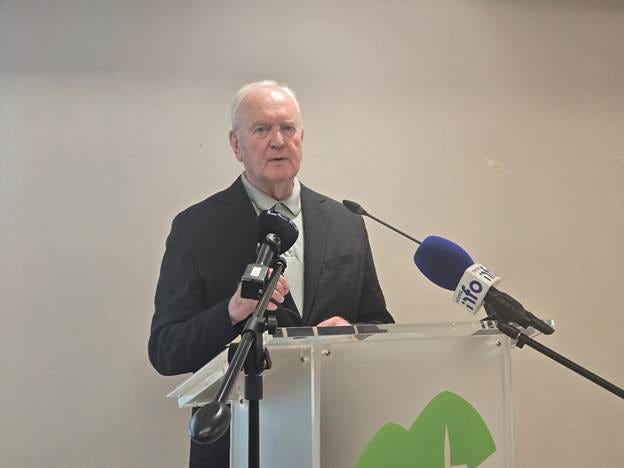
Sutton Mayor Robert Benoît addresses a press conference on June 2, 2026, laying out a detailed timeline of the town’s two-year effort to engage Hydro-Québec over the Brome substation and transmission line project. Photo and video by William Crooks.
Sutton Mayor Robert Benoît opens his June 2, 2026 press conference, where he accused Hydro-Québec of lacking transparency and failing to give fair consideration to alternative routes proposed by municipalities and citizens in the Brome-Missisquoi region.
Get local news like this every morning. Subscribe free below.
Pulse Newsroom
Sutton Mayor Robert Benoît is publicly accusing Hydro-Québec of operating without transparency after the Crown utility announced its preferred route for a major new 120-kilovolt transmission line that will cut through the Brome-Missisquoi region — a decision Benoît says was made while stonewalling two years of legitimate questions from elected officials and citizens alike.
The Brome project is part of a broader electrical system upgrade in Estrie that has been underway since 2016. The region’s aging infrastructure — much of it built between the 1920s and 1940s and operating at full capacity — has been the source of repeated multi-day power outages between 2021 and 2023. The project calls for the construction of a new 120-kV substation in the Brome area, a new transmission line connecting it to the existing grid, and the eventual dismantling of the Sutton, Knowlton, and Eastman substations along with certain 49-kV lines.
Benoît goes public
Benoît held a press conference on June 2 to lay out a detailed and pointed timeline of the municipality’s dealings with Hydro-Québec since the Brome project began taking shape. His remarks came one day after Hydro-Québec held an online webinar on June 1 to brief the public on the project’s progress, including the announcement of the selected substation site and the transmission line corridor still under evaluation.
Benoît acknowledged the need for infrastructure investment but said the way Hydro-Québec has managed the process is unacceptable. “Since the beginning of this process, we have worked in good faith, asked legitimate questions and put forward constructive solutions,” he said. “Despite this, several key pieces of information have never been made public, and alternative scenarios were not subjected to the transparent analysis that citizens had every right to expect.”
Two years of unanswered questions
At the heart of the mayor’s frustration is what he describes as Hydro-Québec’s refusal to share the technical and financial data used to evaluate competing route corridors — including an alternative favoured by Sutton that, he argues, would have significantly reduced impacts on agricultural land, natural environments, and valued landscapes. Benoît told those assembled that the town submitted questions, passed council resolutions, and proposed alternative scenarios over the course of more than two years, only to see the alternatives dismissed without adequate explanation, often within weeks of being tabled.
Benoît, who worked at Hydro-Québec for 30 years earlier in his career, went further, saying the town had never once received an environmental study to accompany Hydro-Québec’s decisions — despite the utility’s own 2022 document on social acceptability, which committed the organization to early landscape consideration, flexible consultation methods, and transparent analysis of alternatives. He described the process as a monologue dressed up as dialogue.
Benoît put the proposed transmission towers at roughly 40 metres tall — about the height of a 12-storey building — and argued that lower-profile alternatives exist that could substantially reduce the visual impact on the region’s landscapes.
“Citizens are entitled to all relevant information,” Benoît said in the Town of Sutton’s written press release. “When a project of this magnitude permanently transforms a territory, it must be assessed with rigour, transparency and a genuine spirit of collaboration.”
This kind of local reporting doesn’t show up in your feed by accident.
Get it delivered daily by subscribing below.
Regional opposition grows
The concerns are not limited to Sutton. The mayor noted that several other elected municipal officials in the region, as well as the Brome-Missisquoi MRC, have formally asked Hydro-Québec to evaluate additional corridors and provide better visualization tools to help residents understand the real-world visual impact of the proposed line.
What Hydro-Québec says
For its part, Hydro-Québec used the June 1 webinar to defend its process as rigorous and community-informed. Project managers said the preferred substation site and line route were selected based on two years of environmental and public participation work, with the stated priorities of avoiding agricultural land, sensitive natural environments, residential areas, and high-value landscapes. The utility acknowledged that further optimization work remains to be done and committed to sharing 2D visibility analyses, visual simulations, and 3D modelling with the public at upcoming open house events.
Open houses scheduled for Cowansville
Those open houses are scheduled for June 10 and 11, from 2 p.m. to 8 p.m. each day, at the Club de l’âge d’or de Cowansville, at 154 rue Principale in Cowansville. Hydro-Québec staff will be present to answer questions, walk residents through mapping tools, and take input on further refinements to the preferred corridor. The June 1 webinar recording is expected to be available for replay on the project’s web page.
According to Hydro-Québec’s published project schedule, permitting is planned for 2026, with construction to follow in 2027 and the new substation and line expected to be commissioned in 2028.
What comes next
Benoît said he intends to continue pressing Hydro-Québec, the provincial government, and regional partners to ensure residents’ concerns are taken seriously in the remaining phases of the project. He did not rule out calling for a formal BAPE public hearing process — Quebec’s environmental review mechanism — if the utility continues to avoid answering the municipality’s outstanding questions on record.
The Town of Sutton has been in opposition to key elements of Hydro-Québec’s approach for some time. Council formally opposed the proposed substation scale in April 2025, called on the utility to listen more closely to local concerns in February 2025, and presented a citizen-led 69-kV alternative line proposal in June 2025.
Brome Lake Mayor Lee Patterson has indicated he is willing to speak with The Pulse following an expected Hydro-Québec press release next week.
Residents and stakeholders who wish to follow the project’s progress can register for Hydro-Québec’s Brome project newsletter through the utility’s website.
Don’t miss the next story that affects your community.
Join thousands of readers getting The Pulse every morning—plus breaking news alerts when it matters most.
If you value this kind of local journalism, consider supporting it.
Subscribe, share and like!
RB's charging ahead on this is a bit of a farce as 2 years ago he argued against (!) any upgrade or increase ... saying we needed only 69 Kwh and not 120 .... all while complaining about the power outages! So what gives? Meanwhile, his new urban plan is putting immense pressure on farmers and the rural landowners with new restrictions, refusal to give citizens adequate info or counselling, refusal to attend a UPA and farmers mtg, NO comparison of old and new urbanism rules (500 pages!)!! So his grandstanding is not to be taken seriously! Citizens are even deprived of full urbanism staff ... the Mayor's concerns are very hard to take seriously in light of this dangerous and opaque rushing through of new urbanism rules with huge co sequences, written by those with questionable knowledge and motives!